
More languages
More actions
Essays reflect solely their author's point of view. We ask only that they respect our Principles.← Back to all essays | Author's essays Decolonizing Caste Mentality and Mixed Identity
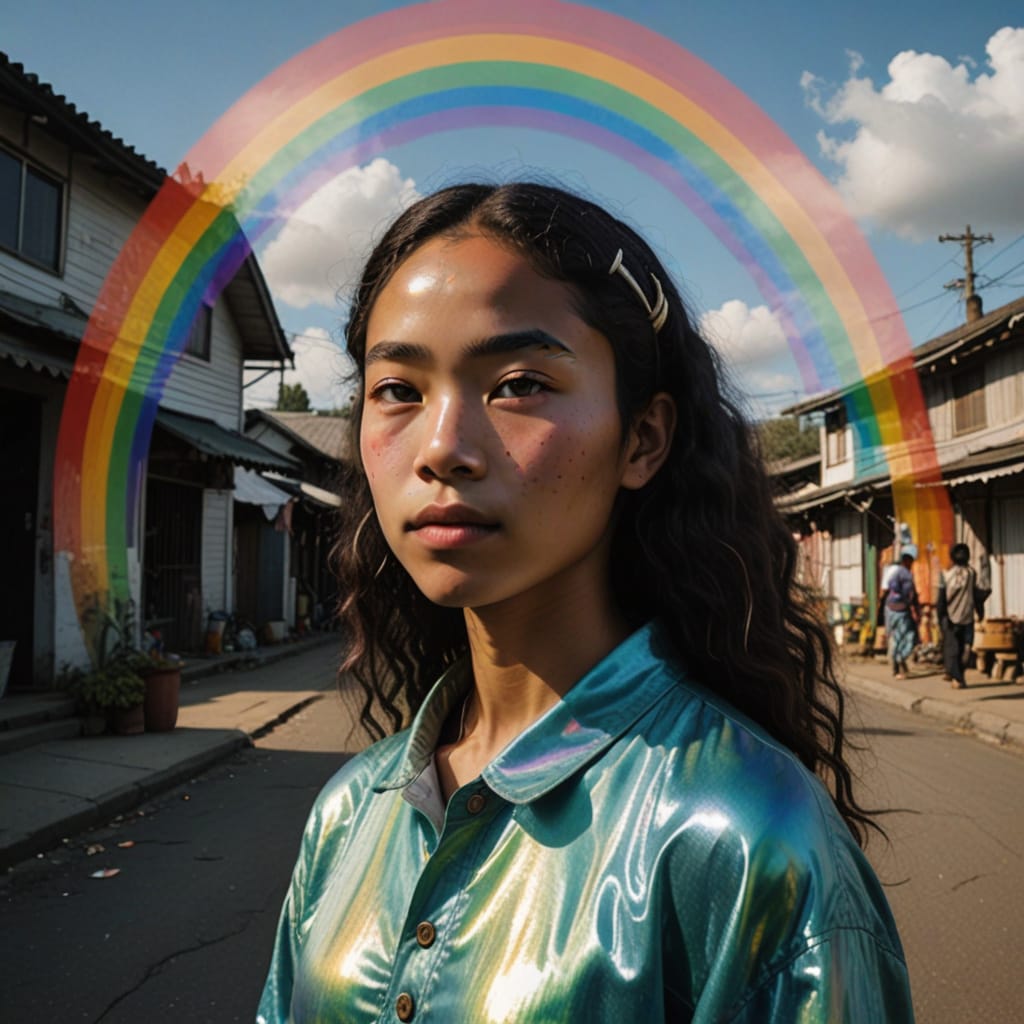
by Charhapiti
Published: 2026-04-16 (last update: 2026-04-16)
5-15 minutes
A mixed person of any racial composition might say:
You may have grown up in your village. But you don't know what it's like to be me in 'your' village. In a village that is in one way or another, mine too. You tell me that everybody just interrogates my existence because they all know each other, everybody knows each other... But they really don't all know each other, I know that. I know the truth. I'm not deluded. You're just being weird and romanticizing. I don't know why you think that you can explain my experience. Because I know what it's like to be racially profiled. I'm from another village, and maybe I'm also from two other continents but ultimately I'm still from here. I'm still from this land. I'm still of this land. And I'm racially profiled. People think that I'm not from any place. You're romanticizing your own village, as if everyone is all united. That's a mask you put on because you see me as the eternal outsider because I look like a (fill-in-the blank) person who should be named '(fill-in-the-blank)', not an indigenous '(fill-in-the-blank)', and while admittedly aspects of me reveal that I am pretty foreign, I am also indigenous in other ways. They interrogate me daily, I tell you, and you say that's normal with a tone of as if they almost should, even though I am embedded within our customs, did you not hear me when I said every conversation is an interrogation where they try to box me in. You will never experience that. Do you not understand that when people ask the question 'where are you from' and do not accept the answer it's not ok, and I refuse to respond further, my answer is no, I won't make it easier for your to squeeze me into the fables of your mind. And somehow it's me who's tripping, not that they're racist.
I may legitimately be (biracial, triracial, third culture kid, or whatever the situation is) but it doesn't mean people aren't lunatics in certain ways.
Do these implicit rules sound familiar?
1. Born and raised – The idea that to be truly "from here," you must have been born there and never left (excluding those who left as children and later returned). 2. Grandparent from another village, who didn't pass the visual racial profiling test – Having even one grandparent from elsewhere who didn't fit a stereotype of being indigenous (even despite being monolingual native) disqualifies you, your children, and all descendants, indefinitely. 3. Phenotype / other-looking face – Someone whose face appears (white, Asian, African, or fille-in-the-blank other) is rejected as "not from here," even if their lineage goes back since the beginning of time in that village. 4. Inverse phenotype test – People who fit the visual profile are accepted as 100% from here, even if they or their parents arrived from another village and settled recently. 5. Gender-conforming clothing – The requirement that women must dress in "our women's clothing" to be counted as from the village; dressing in men's clothing marks you as an outsider. 6. Inherited memory of non-passing appearance – Even if you pass the visual test today, people remember that a grandparent or great-grandparent didn't pass generations ago, and that memory excludes you permanently.
A certain way of thinking would say: well, maybe that stuff is unfair, but you (the biracial, or triracial person) are the real foreigner so don't even think these matters pertain to you. Leave our village matters to us. There's no unity to be had between you and these other people listed.
To complete the picture, none of this happens to people who are genuinely outsiders from another country like Germany. To be a true outsider is to have privilege. Walks into the village. Doesn't speak the language. Doesn't wear the clothing. Doesn't practice the medicine. Has no ancestors in the soil. And what happens? Curiosity, maybe. Hospitality, likely. "Oh, a visitor from Germany! How interesting. Please, tell us about your country." No interrogation. No "where are you really from" followed by rejection of the answer. No purity tests. No generational memory of wrongness.
I also think there is, for the 100% pure ones, an embarassment of being associated with the out casted.
And (for the sake of argument I will characterize this as a caste system) the ones who are what we may as well call in-caste, they are likely to accuse these lower castes of enabling colonizing invaders like me to come and despoil us.
Instead of looking at the in-caste's own arbitrary rules, the problem becomes "disloyal lower castes." The threat isn't the system, it's the people who refuse to enforce it. If the lower castes believe they're "enabling invaders," they might stop defending the mixed person, the perfect outsider-insider. They might turn on the mixed person to prove their loyalty. The in-caste knows that solidarity between excluded people is the only real threat to their power. It romanticizes the past. "Before you came, we were united." Never mind that the lower castes were already being excluded. The in-caste rewrites history so that the arrival of someone like me is the rupture, not their own (potentially) centuries of exclusion. They borrow the words of actual anti-colonial struggle and aim them at the multiracial person who is simultaneously 'from here' and yet also foreign. It's really seen as a perversion to be mixed yet belong. But it works on people who don't look closely.
Why do you suppose these people who are also excluded in more minor ways jump to a mixed person's defense with their own stories of exclusion?
When a lower-caste person defends the mixed person, they're not enabling an invader. They're refusing to be the in-caste's weapon. They're recognizing that this fight and their fight are the same fight. And that terrifies the in-caste, because if the excluded stop fighting each other and start standing together, the whole hierarchy trembles.
If one of them is too friendly with you, others might quietly demote them. Not officially, but in gossip, in invitations not extended, in the cold subtraction of belonging. The embarrassment is anticipatory shame: "What will the others think of me?" They're embarrassed of being mistaken for someone who doesn't understand the rules.
There are also further nuances depending on WHAT you are mixed with.
Across Latin America, there is a long history of blanqueamiento, a social and political policy of "whitening" the population through mixing with Europeans, considered a path to progress. A clear example comes from a village on Mexico's Costa Chica region, where the primarily Afro-descendant community negotiates the national ideology of mestizaje, which often excludes or erases its African roots while valorizing its European and Indigenous heritage.
The U.S. "one-drop rule": It dictated that any person with any known African ancestry was classified as Black. This rule did not apply to people with Asian or European admixture in the same way. In fact, studies show that children of Asian-White couples are much more likely to identify as white than children of Black-White couples.
The ability to "pass" as white has historically been a way for individuals with mixed ancestry to access privileges and escape caste-like discrimination. This phenomenon, documented in places like the antebellum US and Cuba, is almost exclusively an option for those with enough 'European features' to be perceived as white, an option rarely available to those with significant African or Asian admixture.
Psychological studies on "hypodescent" (the rule of assigning mixed-race people the status of their socially subordinate group) show that while it applies to both Asian-white and Black-white individuals, the perception can differ. Asian-white individuals are often categorized as "Asian," showing a visual bias that marks them as different from the white norm. The rule of hypodescent is applied more strongly to Black-white targets than to Asian-white targets. This shows that even within the logic of hypodescent, there is a tiered system where African ancestry is the most socially "sticky."
The existence of triracial communities (Melungeons, Lumbee, etc.) in the Appalachian and southeastern US illustrates this. These groups, often of European, African, and Native American descent, were historically seen as a separate "caste" and faced severe discrimination. Their "mixed" appearance, which could include features read as "Asian" or "Indian," marked them as outsiders to the white-Black binary, and they often had to navigate a complex, caste-like social position.
The Siddis, an ethnic group in India and Pakistan descended from Bantu peoples from Southeast Africa, are a powerful example. Despite having been in India for centuries, they are often racialized and face caste-like discrimination due to their African phenotype. They are largely classified as a "Scheduled Tribe," a category for marginalized groups, highlighting the intersection of race and caste in their exclusion.
In countries like South Africa, Zimbabwe, and Zambia, people of mixed European and African descent were classified as "Coloured," a distinct and subordinate racial category. They were neither "white" nor "native" African and occupied a precarious middle position, often facing discrimination and social exclusion from both groups. This categorization enforced a rigid hierarchy based on the degree of African "blood."
Under apartheid, Coloured people had legal privilege relative to Black Africans (better housing, some political representation, slightly more mobility). Yet Coloured people also experienced racial marginalization from Black Africans (social exclusion, distrust, sometimes violence). So how can someone be both "privileged" and "marginalized"? Because Coloured "privilege" wasn't really power, it was a *buffer zone*. The Black Consciousness Movement explicitly tried to unite Coloured and Black Africans under "Black" identity.
Let's focus on the way Africa handled this. "The Black Consciousness Movement explicitly tried to unite Coloured and Black Africans under "Black" identity."
The system that pits the middle against the bottom so the top stays safe. "Black" identity, in Biko's vision, wasn't about skin tone alone, it was about shared oppression under white supremacy. That included Coloured, Indian, and Black African people. Suddenly, the buffer zone disappears. The pyramid becomes a single floor.
Apartheid spent decades drawing microscopic lines between "native," "coloured," "Asian," "other." The Black Consciousness Movement said: we don't accept your ruler. We are one people.
Asians? Yes there were in fact, many Asian Africans.
Being part Chinese or Indian place you inferior, but being part Japanese made you 'honorary white'
So... Being mixed is a political issue. Not just a personal one...
Anyway... Being called "non-white" or "mixed" or "lesser" becomes, under Black Consciousness, a badge of resistance. You're not less than anything. You're Black, and Black is beautiful, Black is strong, Black is united.
Generations of conditioning don't vanish overnight, however, and in order to make the transformation stick it must be paired with elimination of material inequality.
The only way to eliminate material inequality is socialism: Marxist Leninist, Jucheist, Communist socialism. The one that eliminates the class system.
Biko himself wrote extensively about economic liberation alongside psychological liberation.
The material base determines the ideological superstructure in the final instance, as the Marxist saying goes. But Juche adds that socio-historical processes, including ideological ones like racial hierarchy, purity tests, and caste memory, develop their own relative autonomy and their own internal laws. You can't just wait for the base to change and assume everything else follows mechanically.
In our village's case:
- The material base (colonialism shaping land ownership, inheritance, class relations) created the conditions for the purity tests to emerge.
- But those purity tests have since developed a life of their own. The memory of a great-grandparent's face. The hierarchy of which admixture is "worse." The way a white German is welcomed while others are interrogated. These are not reducible in any simple or immediate way to who owns the mill.
- They have their own momentum, their own logic, their own capacity to persist even if the material base were radically transformed.
A Marxist-Leninist revolution that only changes ownership of land and means of production will not automatically eliminate the village's racial caste system. The socio-historical processes of exclusion: the interrogations, the clothing rules, the inherited memory of non-passing faces, must be contended with directly. As their own front of struggle. With their own analysis, their own strategies, their own timeline.
Juche, with its emphasis on self-reliance, subjectivity, the active role of human consciousness in shaping history, provides a foundation for this work. The subject of revolution is not just a passive product of material conditions but an active force that must take on all the chains: economic, racial, gendered, caste-based, simultaneously and with full awareness that each has its own laws of motion.
I'm not a crude economic determinist. I'm saying: the material is primary in the end, but the ideological has developed such powerful independent momentum that it must be fought on its own terms, with its own methods, as part of the same revolutionary process. Not after the revolution. Within it.