
Essay:Intellectual property in the times of AI: Difference between revisions
More languages
More actions
No edit summary Tag: Visual edit |
No edit summary Tag: Visual edit |
||
| Line 14: | Line 14: | ||
# It's not actually art/it looks bad, | # It's not actually art/it looks bad, | ||
# It's a bubble, | # It's a bubble, | ||
# It destroys jobs | # It destroys jobs | ||
Making any discussion outside of these five hot topics impossible. I know that by pointing out these arguments and responding to them I will invite discussions on them when my goal here is to talk about intellectual property, but I feel I couldn't properly talk about IP laws if I didn't address these arguments first. This is because at its core, these arguments come from a place of not wanting to actually ''struggle'' with the problem. Rather, some people seem to think that if they ignore AI (the ostrich technique) or deride it and its perceived proponents enough, it will suddenly go away. | Making any discussion outside of these five hot topics impossible. I know that by pointing out these arguments and responding to them I will invite discussions on them when my goal here is to talk about intellectual property, but I feel I couldn't properly talk about IP laws if I didn't address these arguments first. This is because at its core, these arguments come from a place of not wanting to actually ''struggle'' with the problem. Rather, some people seem to think that if they ignore AI (the ostrich technique) or deride it and its perceived proponents enough, it will suddenly go away. | ||
Revision as of 09:31, 7 November 2025
Essays reflect solely their author's point of view. We ask only that they respect our Principles.← Back to all essays | Author's essays Intellectual property in the times of AI
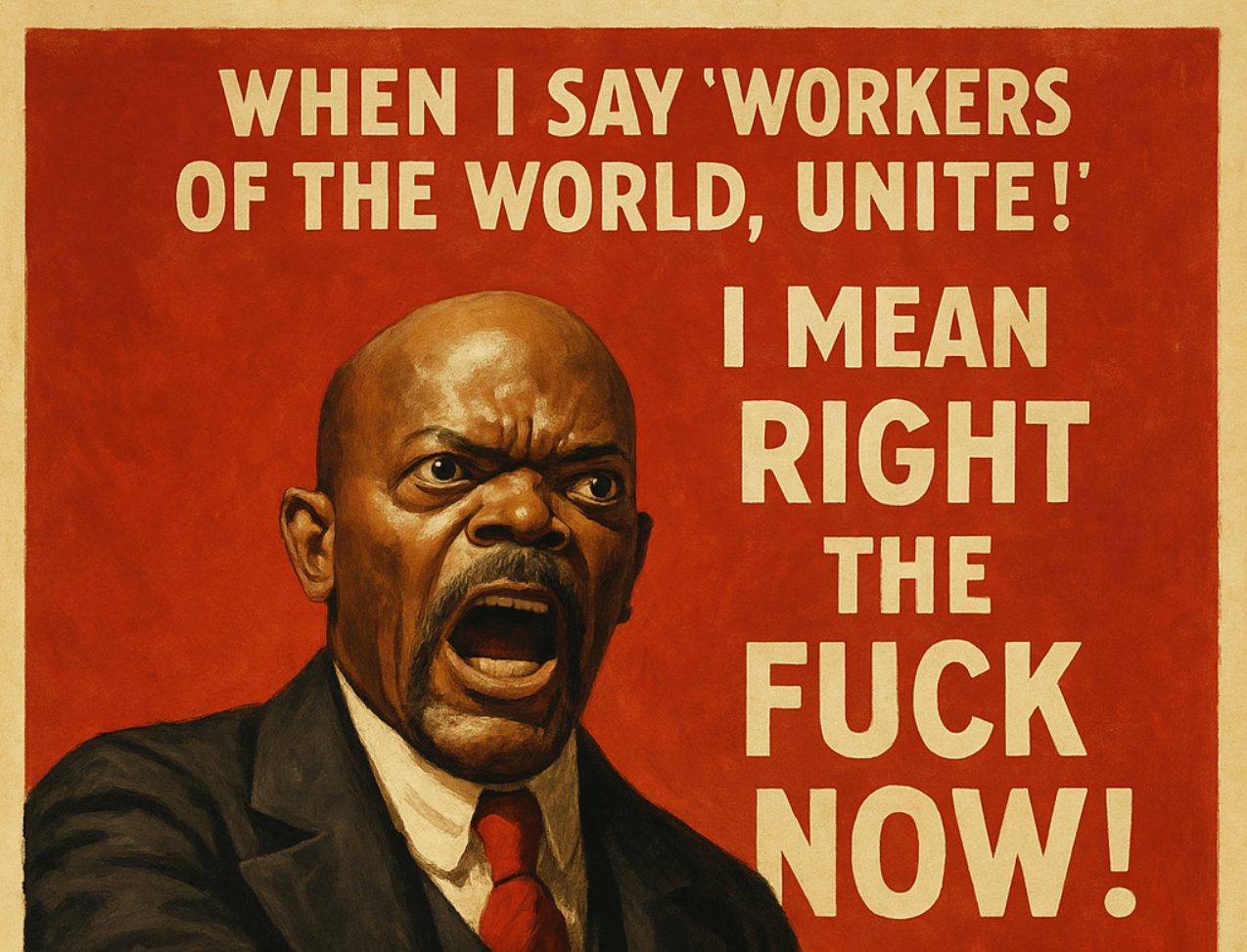
by CriticalResist
Published: 2025-11-07 (last update: 2025-11-07)
40-65 minutes

Commercial AI has existed for the past 3 years, kicked into gear by the release of chatGPT in November 2022. Prior to that, research into machine-learning and neural networks had existed for several decades, though they had trouble finding widespread use due to hardware limitations at the time. It was in the 2000s that "deep learning", the foundation to modern neural networks (which trains what becomes chatGPT, Midjourney, DeepSeek, and all the famous names), became a reality.
Regardless of one's feelings on the matter, we can clearly say that AI has been transformative because it never fails to provoke heated arguments. And not only that, but the arrival of commercial models, that is, models that can be run either in your browser (on a cloud service) or on your own machine (local) seems to have shifted perspectives entirely. What becomes bothersome is that self-proclaimed communists seem to have done a complete 180 on intellectual property, and this is what we want to focus on.
Some definitions first: by AI, I mean modern neural networks specifically -- which includes but is not limited to generative AI such as Large Language Models or image generation models. By art, I mean any of the established art forms: painting (i.e. illustration), sculpture, literature, architecture, film, music, etc. A lot of the discourse around AI and IP (intellectual property) revolves around illustrative output specifically, which completely ignores film, literature and music.
The five arguments of anti-AI
There are many, many things to discuss about AI (both good and bad!), and we'll get into them. But most of the time, AI revolves around five arguments:
- You stop using your brain,
- It's bad for the environment,
- It's not actually art/it looks bad,
- It's a bubble,
- It destroys jobs
Making any discussion outside of these five hot topics impossible. I know that by pointing out these arguments and responding to them I will invite discussions on them when my goal here is to talk about intellectual property, but I feel I couldn't properly talk about IP laws if I didn't address these arguments first. This is because at its core, these arguments come from a place of not wanting to actually struggle with the problem. Rather, some people seem to think that if they ignore AI (the ostrich technique) or deride it and its perceived proponents enough, it will suddenly go away.
But clearly AI is not going away - you can't put the toothpaste back in the tube. This isn't a crypto or NFT situation, this is something that over a billion people have used in their daily life already, and keep adopting. And not only that, but there is a very overlooked open-source ecosystem that goes far beyond what the proprietary likes of openAI or Midjourney offer. Even if you were somehow able to stop AI development completely (which would also mean stopping research into neural networks, including research on medical, industrial or agricultural applications aka stuff that can make our lives better), what would happen to the models living on people's machines right now? They will still exist and still be usable. Open civitai or huggingface right now and look at all the new models coming out every hour of the day, all working on slightly different principles to try and push the limit of what neural models are capable of; and think that this has been going on for 3 years straight and shows no sign of stopping!
Therefore as communists we must struggle with the topic, no matter how uncomfortable it may be, to find its dialectic and resolve the contradictions, from which will emerge a third new thing that did not exist previously. As communists we have had to struggle with many things before, and we will continue to do so. We can't abdicate as soon as something is too difficult to wrap our head around, because our goal is to demystify the world. We don't have the luxury of saying "I'm just not that interested in this" because the bourgeoisie isn't saying this. In fact, they're very happy that we refuse to level the playing field.
This also answers the fourth argument: it's a bubble. Yes, AI in the West (we'll come back to this) is a bubble. It's similar to the dot com boom of the early 2000s: huge, risky investment for a potential future payoff that does not seem to be coming. But overvaluation is not new, and we see that after the dot com bust, the Internet did not go away. Rather what happened was that some companies disappeared, and their property, talent and infrastructure was acquired by what are now today's giants: Amazon, Google (now Alphabet), eBay, Cisco, and Nvidia. They acquired talent and property on the cheap during the bust phase and 20 years later decide for us what goes on and where on the Internet, Amazon and Google especially.
The boom and bust cycle was clearly explained by Marx. A new market emerges, capital floods it and tons of new companies open (the boom phase), but then overproduction lowers the rate of profit, several of these companies go bankrupt and we enter the bust phase. But an equally important part of Marx's analysis is that not all companies go bankrupt in that phase. Those that remain solidify their position in the market, and become monopolies. The boom and bust cycle doesn't just explain economic crises but also the tendency of capitalism to form monopolies.
The belief that AI will go away after the bubble pops is supported neither by theory nor by historical examples. Not only will open-source models still exist and be available after the bust, not only will research into neural networks still take place (by very skilled engineers might I add, who are often completely left out of the conversation), but what will happen is AI will get consolidated into fewer companies. And yes, I do believe AI in the West is an overinflated bubble, predicated on capitalism's own contradictions (the inherent 'anarchy of production' as Engels said and the incessant need to open up new markets because of the tendency for the rate of profit to fall): they are trying to make it profitable and pumping money into it to get a return on investment. But as Chinese models show, AI is actually not that big of a market: it's overvalued.
When Deepseek-r1 came out in January of this year, it completely destroyed the western model of the AI market. Deepseek is a smaller model that came out of nowhere (the parent company is a trading company, so not in AI or even in tech), trained on less than 100 million dollars versus the 1 billion USD openAI swears high and low it absolutely needs. And yet, it delivers similar if not better results. Suddenly, the investment doesn't seem viable and people are realizing they got taken in by capitalist promises.
What we need to be careful about when it comes to the AI bubble is placing it back in its proper theoretical context.
And about the idea that AI destroys your brain: my parents and teachers also said TV would fry my brain and we shouldn't have a calculator in our pocket at all times. What we found instead is that people adapt to new conditions, and have done so for millennia. Do I also stop using my brain when I use a lighter to make a campfire instead of rubbing sticks together? And, is knowing how to make friction fire a required skill in the 21st century? The example is a bit far-fetched, but it's how society advances. Skills come and go when they are no longer socially necessary (taking here after the socially necessary labor time). Who could say today they know how to use a mechanical loom, or a steam locomotive? And yet, our ancestors who did run the steam locomotives would likewise be completely lost if we put them in a modern train cabin.
Many arguments brought against AI today have been made historically, and found insufficient by the passage of time. Some people were also opposed to electrification when it came out -- though a lot of it was spurred by the gas lobby. What we found instead is that gas companies started getting into the electricity market when the writing was on the wall. Today, anyone saying they would rather go back to gas lightning over LED lightbulbs would not be taken seriously. Is AI the modern electric lightbulb? Not necessarily, but maybe? It is clear however that having a kneejerk reaction to it, in either direction, will not seriously answer the question: both from the capitalists that swear it will do everything (LLMs clearly don't and neural networks in general still need more research done into them to find more uses), and from the comrades that think it does nothing whatsoever -- we use it a lot to code front-end stuff on ProleWiki which improves the reading experience of our readers, to name just one usecase. If you use a custom font or the sepia theme while reading this essay, you are using code written by AI.
In the same way, I don't like using the word Luddite. The luddites were a historical movement that do not exist in our current conditions: it's an easy cop-out to not have to make a point. But we need to make arguments, and we need to make them sooner rather than later. But to do that, we need to abandon kneejerk reactions and treat our comrades on an equal level, and one side is more guilty of this than the other. In fact, I already expect many of these reactions to this essay. What I ask for is not necessarily that you become pro-AI and wear "I heart AI" t-shirts today, but that you treat comrades on an equal level and listen to their arguments. And, if you want to remain ambivalent on AI and don't feel like learning how AI works down to the details, then be principled enough to keep it to yourself and let other communists who do want to learn how it works do it for you. Work collectively, from each according to their abilities.
This brings me to the next point: AI art looks bad.
So did the first human paintings on the caves of walls. So do my own illustrations. I say art to mean all art forms, but this argument is usually reserved for illustrative work specifically. But focusing on illustrative art (painting, drawing etc) is a trap; it creates a microcosm that prevents us from looking at the big picture. In fact, generative AI may be able to help circle around IP laws. The actual effect it will have is difficult to predict and we don't have any hope of capitalism doing the right thing, of course, but to me this is a much more important problem to focus on. Yes AI art may look bad, and yes it may not be art, but then what? What has this argument changed in the past 3 years it's been used aside from getting some approving nods in certain circles? Facebook is rife with terrible AI images passed off as real because they opened monetization a few years ago, and so everyone is trying to post as often as possible to get as many impressions as possible to make as much money as possible. Models are getting better and better at generating images, to the point that some look absolutely lifelike. Clearly, the technology is improving, not stagnating. And it will continue to improve no matter how much you might say that it looks bad. AI devs just don't care about this argument, so clearly it's not an effective argument.
This is an image generated by a local, open-source model using only my own GPU:

Does it have artefacts? Yes, probably. The text probably makes no sense and I'm sure looking deep enough into it you might notice some things that are not natural. There's not really a background and the grain of the table looks a bit fake. But it also looks very realistic, and this is where we're at now. 3 years ago image models could not even get books right.
This is what you have to contend with if you want to remain anti-AI, and it will give you much stronger arguments than simply saying "it looks bad" as if that was a given outside of specific circles that already agree with this opinion. The ecosystem is developing and moving with or without you, and with or without me too! Even if we were to ban AI, even if we were to break up openAI, Grok, Gemini, and whatever else exists commercially, even if we stopped all research into AI, even if one thinks 40 seconds to generate this book cover on a wooden tabletop is simply outrageous, we will not be able to remove this model from thousands of people's machines. It will be able to keep creating images like these for years to come.
My point here is that this is the reality we are now in, and arguments about quality have never stopped anyone, because what counts as quality to you may not be so important to someone else. I come from a graphic design background, and when I was in school spec work was all the rage to rally against -- spec work is the practice of a client submitting a design request for which designers submit their work, the client then picks one winner and pays them while the other participants leave with nothing, having performed free labor. For all our posturing, arguing and debating against spec work, we did not stop a single contract from being signed. Why is that? Because there was no real organizing. It was the futile kneejerk reaction to a profession that felt threatened by something they could not stop. Instead of yelling at people to not do spec work and pay money they did not have for a designer they could not afford, designers should have found better arguments and ways to work around spec work: what can a designer provide that spec work can't?
And not all illustrative work is meant to look good. Some is just meant to accompany a blog post, or fill up space in a PowerPoint. Not all illustrative work is art, plainly speaking. First of all because there cannot be true art in capitalism (its nature as a commodity to be bought and sold will always overtake the artistic aspect), and secondly because not everything is inherently art on virtue of being drawn. As a graphic designer, I never thought that the logos and designs I made were art in any way: they exist to convey a marketing intent. We make logos, flyers and videos to get you to buy something, not to hang on your wall and admire. This is why I separate illustrative work from art, not all illustrative work is inherently art.
This also allows me to answer the environmental aspect: first, there is currently a lot of research being done to severely reduce the environmental impact needed to train and run AI. Just recently, Alibaba (who trains Qwen) found an algorithm to squeeze more models on GPUs, reducing the amount of graphics cards needed by 82% in their datacenter. Secondly, once the model is made, these 40 seconds of my GPU being used to make a picture amount to literally 0 watts consumed. Open-source AI is clearly the way forward, as all software is, and this is just one reason in favor of it. What I'm saying is that this isn't just theoretical research, these are innovations China is developing and using right now.
We have to be careful with how we wield environmental arguments because they can very easily be used against the working class if we're not careful. Watching videos on Youtube is also bad for the environment: Youtube hosts centuries worth of footage, and they need datacenters not only to store all of those videos, but also to serve them to you quickly on a web page. A few years ago, it was all the rage on Linkedin to rant about the climate impact of Youtube. When the argument amounts to nothing else than "AI bad for the environment," then the only logical conclusion is that everything is bad for the environment and therefore we shouldn't have anything. No videos to take your mind off work when you come home tired, no Internet to read books and talk to other communists either. This is not only undialectical, but also anti-civilization.
If we were to focus on how datacenters operate currently however, then we could argue for better laws to protect the environment while still retaining data centers. This is something capitalism is very bad at doing (see the Paris Accords), and gives us an angle of attack to organize under. Capitalism will not save the climate, so we need to move beyond capitalism. It's not just the datacenters, it's the whole system. Of course openAI and Google don't care about the environment, there's no mechanism that forces them to care! What matters is making these mechanisms, and then I guarantee we will make sustainable AI in 3 years time. And not just AI, but a sustainable planet that doesn't sacrifice our lives. I called to anti-civilization in the previous paragraph; a lot of people are anti-civilization because they think degrowth is desirable. But there is one very solid argument against any sort of degrowth: saving lives. China is already using remote controlled quadcopters to save people from floods.[1] Billions of people need medication daily to stay alive: before these medications existed, people simply died of preventable diseases. AI is, at this moment, being used in medical applications to help save people's lives.[2] It's just that capitalism is not very good at doing this, and so we need socialism.
There was a similar uproar against 5G when the towers were first being built. Your mileage may vary but everyone I talked to was unequivocally against 5G. They felt 4G was more than enough, and there was an entire thing about how the "microwaves" were going to roast our brain or something. And sure, you could argue 4G is more than enough for browsing the web. But today with 5G, China is performing remote surgery thousands of miles away.[3] This technology is saving lives -- 4G has too much latency and fiber optic can't be laid over a 4000km stretch to make surgery possible. And all this tech isn't just making surgery possible, it's simplifying the entire healthcare process and freeing up doctors' time so they can fit in more patients in their day. A specialist doesn't have to take a plane to and back to perform surgery, he can just load up the device from his location.
All of this ties in with the idea that AI "destroys jobs". Much like the environmental angle, the argument shouldn't be "destroy AI to preserve jobs" -- capitalism nurtures an underclass of unemployed workers regardless, and if we really wanted to preserve jobs then we are essentially arguing for going back to the age of subsistence farming, where you could die of starvation if your harvest was unfavorable and you wore the same clothes until the threads literally dissolved, but at least you had a "job" (working the farm from sunrise to sunset). What I mean is, just having a job is not an end in itself. What we want is to be freed from work, and until then perform unalienated labor that benefits the proletariat.
Interestingly, when electrification came to Sweden and industrial jobs were being cut due to the productivity gains, the demand of striking workers was not to undo electrification and rehire, but rather they argued for better pay. The argument was, if you're going to make me do the work of 10 people, then you can afford to pay me 10x more. This is a much stronger angle because it's universal to every worker: we work more and we take on more responsibilities, so you can pay us more. It speaks to everyone, except to the business owner who is being told "you won't actually make more money by doing this, not if we can help it". The case in point is that illustrators didn't think their work would ever get automated (or if they did they didn't think it would happen so soon). Everybody thinks they're irreplaceable but capitalism shows us no one is.
The effects of AI on the job market however are not so clear-cut. Many companies who were initially taken in by the promises of tech companies to replace their workforce with AI are now walking it back and rehiring, while others are opening up jobs in other areas to make use of AI-assisted human labor. At this time, it is too early to tell what permanent effect AI will have on the job market.
Regardless, we already have the solution to all of these problems: socialism. On ProleWiki, everything we do is in service to the reader. Our design and development philosophy is to make the website more customizable, more able to answer your needs. We don't need you to spend several minutes trying to find the page you're looking for because this would allow us to serve more ads (cough cough Google Search); we just take you to the page you're looking for. We don't serve ads, we don't ask for your money, and we don't need to maximize your time spent on our pages to please investors that don't exist. Our use of AI on ProleWiki is completely different than how it's used by tech companies. And yet, one cannot excise themselves from capitalism no more than forming a commune in the woods is Actually Existing Socialism: open-source models, as interesting as they are, often depend on proprietary models for their training. Capitalist companies themselves make heavy use of open-source code which they reuse for free, and then extinguish once they have milked it dry, becoming the sole provider of a service you now have to pay to use.
Yet, this shows that AI does have a place in socialism and communism. Maybe not a society-transforming place, but a place nonetheless. As AliBaba Cloud's Founder (Wang Jian) said, AI changes the way they think about and approach problems, it's one more tool in their arsenal to solve problems with. This does follow in the idea that AI is not the "fifth industrial revolution" or a "paradigm shift" like its hardest proponents believe, but it also shows that it has legitimate usecases and will continue to have them, it's not merely a "toy" or "slop" like the other side claims.
Capitalism destroys anything good before it even has a chance to start, but that is not new. In AI research there are very smart and skilled people who want to do good things, only to find their research misappropriated to squeeze just a little bit more profits out of this late-stage capitalism hellscape we live in.
AI and intellectual property
As previously mentioned, Chinese models are accelerating the death warrant for overvalued western tech companies. Project Stargate, the $500 billion AI infrastructure initiative launched by president Trump died before it even got off the ground when only two weeks later DeepSeek came out and needed only 100 million dollars and spare GPU power to train. Incidentally, DeepSeek is completely open-source -- as are most Chinese models -- and they contribute a lot to open software development. This has repercussions not just in AI but in all software, because software uses and builds upon what already exists, and this will include AI software too.
Let's talk about training AI. I would ask a question: It is often remarked (and not wrongfully) that we want AI to do our chores so we can focus on our art, but it turned out AI is doing our art so we can do our chores. And yet, how is AI supposed to do our laundry if it can't recognize a laundry basket and use your laundry machine? How will the dirty laundry find itself in the washing machine, and the program started?
To achieve tasks like these, we need to train AI to have vision (a way to understand what an image depicts, either a photograph or a frame from a video feed), and this vision must be trained - just like ours. We didn't come into this world knowing what a laundry basket is, someone had to teach us. We do the same with AI. We teach it to recognize a laundry basket and dirty laundry from clean, and this requires that it has access to enough training data on laundry baskets, but also forks, knives, cats, basically everything that exists in this world that we take for granted.
Will we ever have AI do our chores in capitalism? Not if it's not profitable (which is looking increasingly likely as the bust phase approaches rapidly). But what we wanted as consumers was magical AI, the kind that we saw in movies of the 2000s (I, Robot, The Iron Giant, Wall-E and so on) that somehow works, but not on any scientific (i.e. real world) principles. How does wall-e navigate his environment? Who knows! But now that we have something that may get us there -- but might also still need a bit of research to improve its foundation, neural networks -- we don't want it anymore. That's not because we don't like innovation, but because we don't trust capitalism to deliver the promises.
Meanwhile, Chinese company Unitree is releasing humanoid robots priced between 10 and 70 thousand dollars (!!) which you can get delivered to your doorstep today. Right now the industry is in its very early stage, and these robots come only with an SDK, that is, it has no functions or code within it but only the capability to run what you program (and you can easily use AI to program this robot for you, too). If you want your Unitree bot to go get something from the fridge for example, you will have to figure that out yourself from scratch -- there is not "get.beer.fridge()" function built into it. These are more like skeletons, from an industry that is only just getting its start.
Research often only pays off years later. Maybe we'll find out humanoid robots are not that good at doing chores and we'll end up making a flatbed robot that carries your laundry basket to an Internet-connected washing machine that automatically turns on because that'll be more efficient and cost-effective (although that robot will have to know how to navigate doors and stairs), but it has to start somewhere is my point.
It's not uncommon for new marxist to ask how chores will be socialized in communism (in their process of understand for themselves how labor can be organized differently: will we have people whose job it is to do them, or will we still have our individual laundry machines and vacuum cleaners? And what about at work, will workers be responsible for doing the chores in their own building?
Well, wonder no more. We will have robots that take our dirty laundry off our hands and handle it for us. Again, this isn't science-fiction. This man in the United States bought a 70,000 USD Unitree robot and is programming it to do things around the house as we speak: https://www.youtube.com/watch?v=pPTo62O__CU&list=PLQVvvaa0QuDdNJ7QbjYeDaQd6g5vfR8km. And as for industrial settings, China has built its first "dark" factories, factories that are 100% automated and therefore don't need to keep the lights on (and can also work 24/7).[4] These are not entirely new robots and they don't need vision capabilities, but they make heavy use of AI within these spaces to keep up with production and not have to send human techs to do maintenance. By the way, these factories are building the robots that will be used in more dark factories.
The second thing the discourse generated by AI robots reminds me of is the nuclear issue, which is another hot topic in Europe. Europe has basically decided to abandon nuclear without having anything to replace it with. Germany, once a big producer of nuclear energy, has reopened coal plants to satisfy demand. There is now a huge energy crisis looming in Europe. Most people's argument against nuclear is that it's not safe enough, but no energy source is - in fact, nuclear is actually the safest energy source when comparing historical deaths data (coal doesn't come out of thin air). Another reason nuclear is not "safe" is because we stopped doing research in nuclear tech in the 70s, and our plants in Europe are from that era. But with more research, much of which is done in Iran and China, we see that we can make nuclear energy more efficient and safer. There will come a point where we will be able to recycle 99.9999% of waste. Modern reactors are essentially meltdown-proof, and the Fukushima disaster happened because it was built right next to the sea in a country known for earthquakes and tsunamis, because it was cheaper than pumping the seawater further inland. Profits above people.
Nuclear is but one example, and AI is another. With more research into AI, who knows what will come out of it? And not only as innovations, but as future inventions. In the same way we needed the radio to invent the TV, we will need neural networks to exist to invent something else, something that I obviously can't predict.
But this is exactly what intellectual property laws don't want to happen. IP holders don't want to make safe nuclear reactors or AI that does your chores, they want to make money.
What prompted me to write this essay is that I see many people in anti-AI circles cheer when big names like George R.R. Martin, Studio Ghibli, Shueisha (publisher of Shonen Jump magazine in which many famous series like One Piece, Naruto or Dragon Ball originated) or even Disney sue AI companies over perceived copyright infringement.
And this isn't just the liberals and the apolitical kind cheering for the strong arm of the law; many self-proclaimed communists also rally behind these lawsuits that, they hope, will take down AI, even accepting some adverse effects in the process if it means the end of AI -- which, as we have seen, due to the prevalence of open-source AI is simply a pipe dream. Even if these IP companies won their lawsuits, the models on people's machine would still exist and be usable. It's like trying to remotely delete a film you have downloaded to your hard drive.
In just 3 short years, we have gone from "abolish private property" to "actually maybe some copyright is good". But copyright law has never been made to protect the small artist against unauthorized use of their work. That is not its purpose. In every epoch, the ruling ideas are the ideas of the ruling class - in other words, bourgeois law protects the bourgeoisie, starting all the way back to the first copyright laws down to the quagmire we are in today, where Disney has extensively lobbied to extend copyright to 75 years after the author's death just so they could keep making money off Mickey Mouse.
It reminds me of the old commercial, "You wouldn't download a car". We went from "I totally would if I could" to "no I wouldn't because it might be used to train AI" -- and this is in fact an argument the RIAA is using right now to get you to not pirate the proverbial car! We are sabotaging ourselves just so we don't have to hand anything over to the AI boogeyman. But as communists we are currently not in a position of power, we can't afford to be picky because of some moral principles; we must be dialectical materialists.
When OpenAI introduced the Ghibli style to its image model Dall-e, people felt it as a direct attack on themselves because they identify so much with the Ghibli style, despite that the Ghibli style neither belongs to the people nor was invented by the people. It was invented by a company, the joint-stock Studio Ghibli company (incorporated), of which Hayao Miyazaki is the co-founder - therefore he of course has an interest in protecting what he considers to be Ghibli's style, so he can become its sole provider. The art style was cultivated to be commercially viable and sell merchandise. Case in point, Ghibli sold officially-licensed and very cute Grave of the Fireflies tin cans of hard candy in the 1980s as a tie-in to a movie about war orphans surviving the firebombing of Kobe.[5] It's also often pointed out when this topic comes up that Miyazaki is against AI, as if he was a thought leader on art or AI or had the same class interests we do. He's a business owner and thinks about business first, because no matter how well-intentioned he might be, no business means no way to tell the stories he wants to tell.
Once can like Ghibli vibes if they want, which is not limited to just the illustrative work but the entire movie package, with the music, animation etc -- but the point is that it's an aesthetic born under capitalism and subject to its contradictions. Ghibli movies are here to sell you a product and from this angle, openAI is not so different because openAI also wants to sell you a product, and they will emulate popular art styles to help them do it. In addition, Ghibli and other companies have very obvious interests in edifying their art styles to something that seemingly "can't" be copied even by the most hardcore fans. It makes Ghibli the sole cultural provider of such a style, which people like for its cozy vibes and "warmth". Basically, if you want to feel cozy, put on a Ghibli movie - nothing else comes close. It ties into a point the essay Artisanal Intelligence makes (paraphrased): that before AI, artists claimed what they did was not so special and anyone could be creative. After AI, some suddenly switched to making creativity something only a select few are capable of.[6] Artisanal Intelligence can be considered the foundation to this essay in fact and I highly recommend you read it (click ref 2).
Ghibli Studio is also suing openAI on copyright infringement grounds. Miyazaki is often thought of as a progressive, in that his movies often talk about war, climate change or other social issues, and yet we see that he his not above using copyright law when it suits him. In fact, as if this whole saga wasn't complex enough already, when OpenAI made a huge deal about their dall-e model being able to do Ghibli style, they were intentionally banking on the angle that they were somehow champions of the people for making art available to the masses, when in reality openAI is very protective of its own IP, including dall-e itself.
And while you might agree with Ghibli's lawsuits on openAI, the proletarian distinction is understanding that the legal argument they make can also be used to repress the workers and not just other companies. In a DotB, bourgeois infighting has consequences for the workers.
Regarding the results of these lawsuits, the first thing we see is that the courts often rule in favor of the AI company. This is because the companies bringing these lawsuits, most of which are in the entertainment industry, argue on the training of the model. Currently, training takes place by giving a model trillions of images/texts to work on, so that it can learn to recognize patterns. In an LLM, the model starts to learn which words tend to follow each other.
But this isn't simply a Markov chain or pattern-matching like any program can already do. Through this process, the AI creates a neural network of its own, often referred to as a 'black box'. This network only speaks to the model: it learns to create its own neurons through the training process and connects them in a way that makes sense to it. Here is an example of what a very simple neural network might look like:

Deepseek-r1 is also named "Deepseek:671B", with the B indicating how many neurons it has (in this case 671 billion, whereas the image above only has 22). When recalling information, LLMs don't simply copy and paste from their training data -- an argument that was propagated early on but has now thankfully been abandoned, because it was always a misconception. When you send Deepseek a prompt, the data transits through its neural network to create an output token, and then another, and another. How exactly your prompt travels through the neural network, which neurons the model uses, and how these neurons are connected is for the LLM to decide and the data wouldn't make sense to a human observer either way. But it's not magic, it's math.
Image generation works similarly, and if you're interested I recommend this Youtube video from Computerphile narrated by Dr Mike Pound who is, incidentally, very excited about Deepseek and other open-source Chinese models because it allows him to do a lot of research in his field for which he publishes academic papers. The short of it is AI images are created from random gaussian noise, the same white noise that used to be on cathode TVs when you tuned to an unassigned channel. The model that creates the image is also a neural network. Early on when commercial image models appeared, a common argument I saw against them was that they "spliced together" thousands of images together to create an output, but this is not true: they actually learn to undo the gaussian noise on a picture to which it was applied by creating their own neural network. Thus when making an image from scratch, a model starts with what was only ever random noise. Therefore, AI does not copy existing material: the training data is not even located within the model, only the resulting neural network is.
So far, the courts were not convinced by IP holders' argument that training AI constitutes copyright infringement in itself. Rather, the courts believe it falls under fair use - and I think that's a very important point to note.
For one, I made sure to use the word neural network in the paragraphs above because you are very intimate with one of those: your own brain. The human brain works on a network of neurons, i.e. it's a neural network. AI may "only" be an approximation of the human neural network (much like a camera is only an approximation of our own eyes but I digress), but let me ask this open question: if IP companies successfully stop AI training in a court of law and set a precedent, what stops them from coming after you? After all, in the process of learning to draw your own Ghibli scene on Krita, you had to study the Ghibli style, activating your neurons and "training" yourself to then draw that style. What stops them from making the claim that their style is the IP, and not just the characters or the script, because models such as Dall-e are able to replicate their style?
We know full well that IP companies want to be your sole provider for their IP, and not just in the entertainment industry. Adobe wants to be the only company that does photo editing. Microsoft wants to be the only company that makes Operating Systems. It's in the DNA of any capitalist enterprise to create a monopoly. This is why they create IP in the first place: they wouldn't make their product (under a capitalist context) if there was no way to make money from it. If Shonen Jump wins its lawsuit against OpenAI, what would stop them from coming after you for drawing One Piece fan art, how would you prove it's not AI, how would you find the money to defend yourself in court? I'm addressing the artists reading this specifically here.
This is not far-fetched. Nintendo is a well-known litigator over IP, to the point that they believe they own the whole monster-taming genre because they own Pokémon. They have brought emulator developers to court and won, even forcing a man to pay back the millions Nintendo "feels" they lost to him hacking the Switch for others - a sum he will be paying off for the rest of his life, even as Nintendo was made aware he would never be able to pay everything back before he dies. He is effectively Nintendo's slave. His name is Gary Bowser.[7] In many cases, these emulators are the only way to play old video games that publishers are sitting on and refuse to make available, simply because they don't believe it's a worthwhile investment from their part.
I feel there's been an entire reversal of copyright and intellectual property, where suddenly self-proclaimed communists side with big companies just to stick it to AI. It feels completely backwards. It's not just about making One Piece fan art on DeviantArt that only 30 people will ever see, it's about making all IP free to use and remix. This is why we have Creative Commons licences. This is why we have fair use. Fair use has been used for decades by small creators of all kinds (including software developers and researchers) to create things, as it's the only tool we have to try and curtail the behemoth that is copyright law. It's come to the point where a self-proclaimed communist with a Deadpool profile picture (note the irony) verbatim told me he didn't "care about throwing fanfic writers under the bus if it stops AI".
And yet IP companies already make heavy use of open-source and even copyrighted work, including fan artwork without compensation or any care for "the law" -- for example the clothing brand Zara is repeatedly found to be stealing designs from artists to put on their t-shirts without compensation. Microsoft is notorious for relying on open-source code, they even pioneered the embrace, extend, extinguish policy to turn open-source contributions made with free labor into their own IP.[8] They like open source and fan art when it suits them, and want to control it when it doesn't, because capitalism. And they know they can get away with it because they have money for lawsuits and you don't, and AI or not it doesn't change the fact that Nintendo can and will and has bankrupted people with a lawsuit if they want to drag it on, all for one instance of perceived infringement.
It's also notable that when ICE published a horrifying video that used the Pokémon theme song Gotta catch'em all to footage of them kidnapping citizens off the streets, Nintendo used the DMCA mechanism to take the video down but did not sue the Department of Homeland Security; they only call the courts for people who can't afford lawyers[9] (i.e. me and you) because these are open and shut cases.
What proponents of these lawsuits will have to explain is: beyond "destroying AI", what exactly do they think these lawsuits achieve that's beneficial to them? Not even to the proletariat as a class, but to them specifically. What do you gain from preventing a Mario fangame on itch.io while AI continues to be developed and new models are released hourly?
Shueisha has no leg to stand on in its lawsuit against Sora (the video generation tool recently released by OpenAI) because a- the training process has already been litigated and found to be fair use and b- the output is not a copy of a One Piece episode, it wasn't lifted off a DVD or anything. Therefore it's transformative, an integral part of fair use.
Speaking of copying, it's interesting that many people have gone back to the outdated "stealing" phraseology that we used to hear from RIAA anti-piracy ads. The RIAA is the Recording Industry Association of America. But piracy is not stealing, and neither is training AI with a dataset; it's copying. There's a very clear difference between the two, and this was settled over two decades ago already. Yet some artists are now bringing the "stealing" wordage back, when they spent the entirety of 2021 telling NFT owners that they could just "right click -> save" their expensive ape drawing.
Speaking of the RIAA, it's interesting to note that they are trying to enlist the help of indie artists to lobby against AI, when piracy is historically often what made small artists famous, and also gives them independence from controlling labels and even streaming services, as streaming services can ban you and your music for any reason without recourse. If you're not familiar with the RIAA, they basically represent the big three record labels: Sony, Universal, and Warner. If the RIAA gets its way with its AI lawsuits, it will force indie artists into an even more precarious position than they already are. Yet this hasn't stopped the RIAA from enlisting A2IM (The American Association of Independent Music) or MWA (the Music Workers Alliance) in recent legal actions against "unauthorized use of copyrighted music in AI training models". These two groups may not represent all artists, but a lot of "independent" record labels are members, and they happily joined the RIAA in these lawsuits.
Does AI music threaten your livelihood as a small artist? No more than your livelihood is already precarious because of associations like the RIAA, whose labels control your revenue share, distribution and market access without giving you any leverage or negotiating power. What the RIAA is afraid of is not AI, but losing control over music, including your music. They are trying to retain their monopoly and limit your negotiating power. They claim to protect you against AI music so they can keep exploiting you. It's the same reasons they fought against piracy back in the day, and digital distribution before that. If they can't profit from it, then they don't want it to exist for anyone. The RIAA was even against early mp3 players.[10]
If the RIAA were to win against AI, they would win leverage into how music is produced and distributed. Not only would they remove a potential competitor to their lobby, it would also reinforce their power to decide who can enter the music market, on their terms. In fact, judging from historical examples, it's very likely that if the RIAA can't destroy AI music generation entirely, they will suddenly flip: adopt it and try to control it so that you can only make or get AI music with their permission. And regardless of your thoughts on AI music, this shouldn't be desirable to anyone that actually cares about music period.
Likewise, if Shueisha or others manage to attack the transformative aspect of fair use, then they can reinforce copyright and IP law in their favor by setting a precedent. And you're still not going to be protected if you are a creative, because you don't have the money to scour the web to find copyright infringement and litigate it in court. Even if lobbies such as the RIAA say they will protect you with their lobbying, they won't. You're on your own. But Shueisha will be very happy to come after you for drawing One Piece fan art for a commission (and then probably steal it for their own promo art). They will be very happy to force you to pay what little money you make for the rest of your life to pay not actual damage, but perceived damage to their profits.
And IP is more than just One Piece and A Song of Ice and Fire. IP is also software, medication and medical devices, patents of all kinds, or even shapes (like the Nike swoosh). These all form intellectual property. And yes, unironically, chatGPT models are also intellectual property: they belong to openAI who holds them as close trade secrets and would sue if someone were to publish their outdated GPT-o3 model on huggingface.
Patents are even given out to game and software mechanics, and patents can even be bought and sold. There come to exist patent trolls, companies whose only business model is to buy up all sorts of patents and then sue anyone that they feel breaches the patent without authorization. If you remember "arrows guiding the player to the objective" in video games from the 2010s and wonder why they suddenly disappeared, patent law is why: a patent was filed for it, and so games either had to pay outrageous prices or find another mechanic that's not patented.
And it's not just video games. The examples abound in open software. For a long time Microsoft did not allow copyleft/open-source software on its Microsoft Store. Windows only supports Chromium and Gecko browser engines, by choice (used in Chrome and Firefox respectively). Amazon's Kindle format tries to control e-books, preventing you from installing any e-book but their specific DRM format to your Kindle. Apple prevents you from installing apps anywhere but from their AppStore on iOS. This isn't for security reasons, it's just a mercantile choice so that you have no choice but to give them your money. And with their leverage, they can easily extinguish other alternatives: Dailymotion tried to be the competition to Youtube (although DM was proprietary too), and Google's response was to derank Dailymotion from their search engine to promote Youtube instead. Google also ran ads for Youtube on its own platform and prevented Dailymotion from running theirs. This is why you go on Youtube to watch videos and nowhere else. This is directly tied to intellectual property because Youtube, Kindle, iOS etc are classified as intellectual property, being software, and they legally belong to a company and not to the people.
If they could have their way, Microsoft would only have you use Windows OS with the Edge browser, Microsoft Office and Bing as your search engine. In Europe, they had to be brought to court several times to allow competition on their OS.
I feel with the advent of commercial AI we now have to argue for basic liberation of IP that the USSR had settled a hundred years ago already. I feel I now have to explain why communists should not want copyright to exist. Like I said earlier, Dr. Mike Pound is very excited for Chinese AI models that are open-source, because he can use them in research freely. He can fine-tune their training for his needs and create things. I don't know what research Dr. Pound is involved with currently, but I know that neural networks have already been used in the medical field to help analyze radio imagery and detect diseases. In China, neural networks are being deployed right now for what is called 'precision farming': AI-supported irrigation and fertilization systems that deliver nutrients based on real-time soil data. This boosts soil health, fights against soil degradation, and ensures food safety.
These models don't come out of nowhere: they rely on a whole host of prior open-source research and software packages that are freely accessible and usable. China, working under a socialist system completely different from the capitalist one we know, embraces open software, and they are now leading the AI race, and the US follows. In fact, the five most popular open-source AI models are all Chinese. This is incidentally also a very strong argument for China in the 21st century: just go on the r/OpenLLaMa subreddit, and you will find plenty of non-communists gushing about China because they're the only ones offering an actual competitive alternative to western, proprietary models.
I often make the argument that if you don't like AI, you should like China because they are exposing how overvalued the western AI industry is. And if you like AI, you should also like China because they are putting out a ton of research and promoting more research by releasing their models for free. Basically, we should be more like China.
When we ask "how come western AI companies only focus on making AI a chatbot friend, therapist, or question answerer" we get our answer: unsurprisingly, it's capitalism. They're not interested in making a product for public good (i.e. the proletariat), they're interested in making money. This is why OpenAI is discussing allowing erotica on chatGPT,[11] i.e. trying to stop the bubble from popping by getting a few more 20$ subscriptions, while China is actually using AI to solve societal-level problems.

(The top 5 downloaded open-source models on LMArena are all from China.)
It's no wonder that the global south is adopting AI, yet the anti-AI crowd mostly wants to focus on openAI who, while being a major player at the forefront of AI innovation -- they pioneered Chain-of-Thought that Deepseek has made popular, but keep GPT's chain of thought hidden from the user, which is counterproductive for researchers -- is also only a tiny part of a much bigger ecosystem that transcends IP and borders. It's missing the forest for the trees, literally. Iran recently published academic guidelines surrounding the use of AI (as related to me by a fellow ProleWiki editor currently studying in Iran): they allow LLM use provided the student notes the model and time of usage, and can prove they understand the material. Cuba is working on making its own Large Language Model.
When I brought up to an (admittedly random) communist that Beijing was teaching middle- through high-school students AI for a reason,[12] they dismissed this fact entirely, ending the matter by saying that "China is wrong", period. To them, there was nothing to discuss about this, it was preferable to close their eyes and pretend it wasn't happening. No struggle is even needed: they know more than anyone else. That is not the correct stance to take, nor is it to proclaim "China does everything right". The correct stance is to ask: what do they see in AI that we don't? Why are they teaching it while we want to keep it out of classrooms at any cost? Struggling with this question is dialectics.
China's use of AI in agriculture makes perfect sense when one considers that 1- they have to feed 1.5 billion people, 2- they have to develop self-sufficiency everywhere as sanctions have been enacted against AES and countries that go against the imperial order, and c- prior to the establishment of the People's Republic, famines used to hit China every 10-20 years. It makes complete sense then why China would want to put effort into AI: they would invest in anything that could ensure food security, and today it happens to be AI. And because their system works for the people and not for corporations, success is determined not in quarterly returns or how many 20$/month subscription plans they can sell, but in how much agricultural output increases. If output doesn't actually increase, then they go back to the drawing board. In the west, the company selling you their expensive system would just try to convince you you're using it wrong.
The same can be said of Iran. Under heavy sanctions, they have to find ways to develop rapidly. Any time Iran does some research into nuclear (so they can build reactors and medical imagery devices), the US enacts more sanctions against them. The USSR did the same (albeit under different circumstances): in two generations, the USSR went from a post-feudal country with an entrenched nobility to beating the Nazis to going into space. An argument I sometimes still see around AI is "we don't need it anyway", but that's true of everything - we don't even need fire to live, really. But the point is, had the USSR said "we don't need the steam machine to work the fields, the serf system has served us well for hundreds of years" they would have never caught up with the huge gap between Russia and the West and they would have been destroyed either by the White Army or the Nazis.
Is AI existential for the global south? That remains to be seen. But what's pretty certain at this point is that AI is not going away (chiefly because you cannot legislate what happens outside of your borders), and to take ourselves out of the conversation regarding AI on grounds that it's icky or we don't like it is only ceding ground to the bourgeoisie that will and is using it right now. It's like the advent of missile warfare when the first missiles came out: it was certainly a huge game changer on the battlefield, and missiles are certainly used to kill people, but to refuse to use them too because they might be scary (i.e. moral grounds) means that you will not be able to fight against the enemy effectively. What we need to do with AI is study it, struggle with it, and reach a proletarian line on it that counters the bourgeois line on AI. And a proletarian line necessarily finds that workers need free research, free art, and free software.
I illustrated this essay with an AI picture of Samuel Jackson as Lenin for this reason: it is onto us to find how to make best use of this technology, regardless of what capitalists want to sell us. We refuse their solutions and create our own. The image in question was posted on the subreddit r/AIArt where it's one of the best-rated post (1439 upvotes), and they are not communists by any stretch. Even communists who are usually anti-AI responded well to this image when it came out. My point is that there is agitprop potential in there, on top of what I already said about how we use it when developing for ProleWiki, and I'm sure there's a lot more uses to make out of it that are only waiting to be discovered, shared and refined. But this won't happen while we are still stuck in "you used AI? That's bad and you should feel terrible end of discussion".
In fact, I posit that AI will allow people to do things they couldn't have done before. Before the days of AI which seem so far away now, creatives that could not bring their vision to life would simply give up. Not everyone who wanted art for their game or to illustrate their novel learned to draw. Those that could not afford a dedicated artist simply gave up, and their project never took off the ground.
Moreover, I think a lot of people will change their mind on AI if they start using it (I know I did), and perhaps that's what they're scared of. But as communists, we can't afford to be scared. If we were, then we wouldn't believe communism is possible.
References
- ↑ https://www.youtube.com/shorts/OCWByPxZsiM Drone rescues man from flood, China
- ↑ https://chinahealthpulse.substack.com/p/ai-and-health-in-china-an-essential
- ↑ https://www.euronews.com/health/2025/09/09/worlds-first-5g-remote-robotic-surgery-performed-at-extreme-altitude-in-china
- ↑ https://www.ien.com/redzone/blog/22948773/the-tech-enabling-chinas-dark-factories
- ↑ https://xenosagaepisodeone.tumblr.com/post/779322203162427392/i-feel-as-if-studio-ghibli-films-being-reduced-to
- ↑ https://polclarissou.com/boudoir/posts/2023-02-03-Artisanal-Intelligence.html
- ↑ https://www.gamingbible.com/news/nintendo-forces-switch-hacker-to-pay-them-2530-of-his-income-for-res-170600-20230419
- ↑ https://en.wikipedia.org/wiki/Embrace,_extend,_and_extinguish (wikipedia lol)
- ↑ https://inngot.com/news-views/pok%C3%A9mon-company-international-says-did-not-give-permission-for-us-dhs-and-ice-viral-videos-to-use-copyright-music-and-images
- ↑ https://open.mitchellhamline.edu/cgi/viewcontent.cgi?referer=&httpsredir=1&article=1868&context=wmlr
- ↑ https://completeaitraining.com/news/openai-eases-chatgpt-rules-letting-verified-adults-generate/
- ↑ https://coingeek.com/beijing-leads-china-push-for-ai-education-in-public-schools/